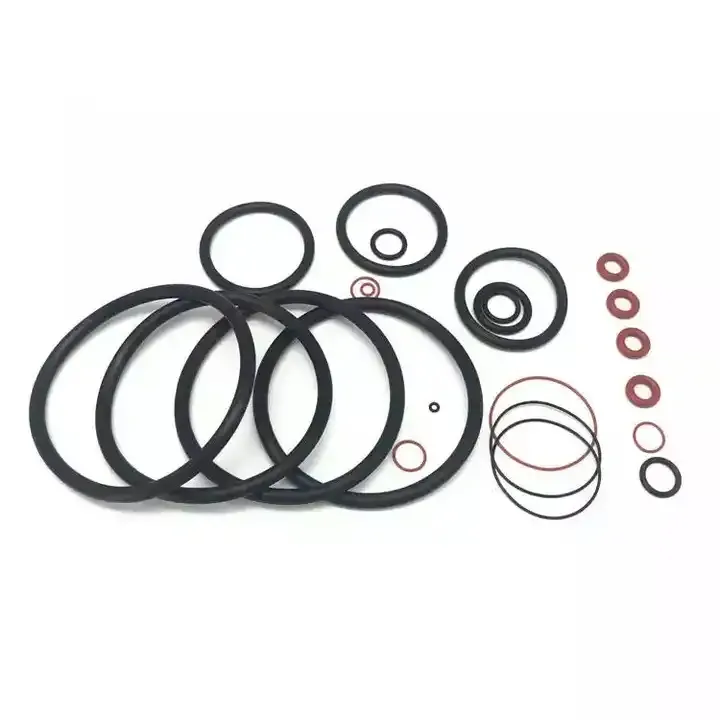
Introduction To FVMQ
We are an OEM & ODM manufacturer in China,and we have full experience with excellent R&D team in custom molded rubber & silicone parts, seals, buttons, stopper, gifts, etc. We can provide to our customers in-house tooling, samples within 7 days, 100% inspection, PPAP and small MOQ.
Introduction To FVMQ
FVMQ Material Description
Introduction
The mechanical and physical properties are very similar to silicone.
However, Flourosilicone offers improved fuel and mineral oil resistance but poor hot-air resistance in comparison.
Suggested operating temperature (-100° to 350° F). Trade names include FSE® (General Electric Co.), Silastic® (Dow Chemical), and Sylon® (3M Corporation).
| Tensile Strength(MPa) | Elongation(%) | Working temperature(°F) | Volume resistance( Ω・cm, 25°C ) |
| 6.0 ~ 13.0 | 300 ~ 500 | -100 ~ 350 | 1010~1014 |
Important features
Oil resistance, solvent resistance, chemical resistance
Its oil resistance, solvent resistance and chemical resistance are extremely good; It can be said that fluorosilicone rubber is the only elastomer that is resistant to non-polar media at –100°F ~ 350°F.
Even in gasoline/methanol hybrid systems, there is almost no change after a long impregnation test of 500h.
Electrical properties and radiation resistance
The electrical properties of fluorosilicone rubber are similar to those of ordinary silicone rubber, but the special value is that there is little change under harsh conditions such as high temperature, low temperature, humidity, oil, solvent, chemicals, and ozone.
Physical and mechanical properties
Fluorosilicone rubber, like ordinary silicone rubber, has a relatively low mechanical strength (especially tear strength).
Other features
Fluorosilicone rubber has excellent weather aging resistance and maintains good performance even after 5 years of exposure.